Canadian Northern Economic Development Agency 2025-2026 Departmental Results Report
Table of contents
Copyright information
© His Majesty the King in Right of Canada, as represented by the Minister of Northern and Arctic Affairs and Minister responsible for the Canadian Northern Economic Development Agency, 2026
Catalogue Number: R105 3E PDF
ISSN: 2561-2921
Aussi disponible en français sous le titre : Rapport sur les résultats ministériels 2025–2026
Note: CanNor used a generative AI tool (ChatGPT) to support the development of content related to Pilimmaksaivik as well as developing some of the text in the analysis of the last three years of spending in the Spending and Human Resources section. A human has reviewed and validated all AI-generated content.
At a glance
This departmental results report details the Canadian Northern Economic Development Agency's (CanNor's) actual accomplishments against the plans, priorities and expected results outlined in its 2025–26 Departmental Plan.
These results align with the priorities outlined in the May 21, 2025, mandate letter from the Prime Minister, as well as with CanNor's vision, mission, raison d'être and operating context.
Key priorities
CanNor identified the following key priorities for 2025–26:
- Collaborate with Northerners, Indigenous Peoples, communities, businesses, organizations, as well as other federal departments, territorial and Indigenous governments to build sustainable, diversified, resilient, and prosperous economies in the territories that contribute to a unified Canadian economy by:
- Promoting inclusive economic participation and resilient economies in the territories by prioritizing high-impact sectors and enhancing sector diversification;
- Leveraging emerging economic initiatives arising from the prospective investments in Arctic securitization, ensuring Northerners are equipped to participate in, and benefit from, these developments; and,
- Strengthening partnerships with public and private sector members, First Nations, Inuit and Métis partners to support research, stimulate innovative programming, and facilitate informed decision-making in economic development policy initiatives.
- Contribute to improving regulatory efficiencies and fulfillment of consultation obligations in environmental assessments and regulatory processes across the territories, while providing additional support for clean growth projects as part of Canada's transition towards net zero.
- Advance Canada's reconciliation journey, working directly with Indigenous communities and businesses to ensure inclusive economic participation and development, as well as furthering Article 23 of the Nunavut Agreement (PDF), and Article 22 under the Umbrella Final Agreement, and supporting federal commitments under the Arctic and Northern Policy Framework, Modern Treaty Policy, Inuit Nunangat Policy, and the United Nations Declaration on the Rights of Indigenous Peoples Act.
Highlights
CanNor works with Northerners, Indigenous partners, businesses, communities and governments to support sustainable, diversified and resilient economies across the territories. Below are some of the important activities and results that CanNor achieved in fiscal year (FY) 2025–26.
Through the Support to Northern Infrastructure Development (SNID) Initiative, CanNor invested up to $4.45M in the Grays Bay Road and Port project. This project supports key development-phase activities required to advance the project through regulatory review, paving the way for the development of a deep-water port at Grays Bay and an all-season road linking the site to the Nunavut–Northwest Territories (NWT) border, strengthening northern trade corridors and enhancing access to global markets for Northern products. This investment reflects CanNor's commitment to advancing nation-building infrastructure by investing in Nunavut's first all-season road, connecting the territory to the national transportation system and supporting long-term economic development opportunities through access to the mineral-rich Slave Geological Province. Through the investment in Grays Bay Road and Port and other projects funded through SNID and other CanNor programs like IDEANorth, CanNor continues to work with Northern, Indigenous partners, communities, businesses, and governments to help de-risk and accelerate more northern infrastructure projects to shovel-ready status, while supporting long-term economic benefits for Northern and Indigenous communities.
The Northern Projects Management Office (NPMO) improves the efficiency and predictability of federal participation in impact assessment and regulatory review processes in the territories. In Fiscal Year (FY) 2025–26, NPMO oversaw and coordinated impact assessment or regulatory review processes for 17 major projects across the Yukon, NWT and Nunavut, including related Crown consultation and participation of 16 federal departments and agencies. Key achievements include:
- Supporting federal decision makers in fulfilling their duty to consult obligations for, and make informed decisions on impact assessments of, the Faro Mine Remediation Project, the Mayo Generating Station Relicensing Project, and the Whitehorse Rapids Hydroelectric Generating Station Environmental Assessments.
- Signing the first-ever project-specific consultation protocol, co-developed with an Indigenous government, to support meaningful Crown consultation during an upcoming impact assessment of a major resource development project in the Yukon.
Within Pilimmaksaivik, CanNor continued to implement the Whole-of-Government Inuit Employment Plan and advance Article 23 of the Nunavut Agreement by supporting Inuit recruitment, retention, advancement and training across federal departments. In FY 2025-26, this included hosting the inaugural Article 23 Gathering in Iqaluit, bringing together 23 organizations and 91 participants to identify opportunities to strengthen pre-employment training pathways and increase Inuit participation in the federal public service.
Pilimmaksaivik invested in building a skilled Inuit workforce through initiatives such as the Sivuliqtiunirmut Leadership Training (SILT) program, the Ilipallianniq Education Support Fund (IESF), the Inuktut Language Training Fund (ILTF), coaching and mentorship programming, and planning for the next cohort of the Inuit Learning and Development Program (ILDP). These investments support long-term economic participation and help ensure that Inuit are prepared to benefit from emerging opportunities associated with public service employment.
Total Spending and Staffing:
- Total actual spending (including internal services): $105,792,273
- Total full-time equivalent staff (including internal services): 124
For detailed information on CanNor's total spending and human resources, read the Spending and human resources section of this report.
Summary of results
The following provides a summary of the results the department achieved in 2025–26 under its "core responsibility".
Core responsibility 1: Economic Development in the Territories
Actual spending: $97,052,163
Actual human resources: 91
In FY 2025–26, CanNor worked to support major projects in the territories, advance Arctic security and defence, advance Indigenous economic reconciliation, improve housing, expand access to clean energy, improve food systems in the territories, support a skilled workforce, and develop, grow and diversify territorial economies. In total, CanNor provided close to $70M to support 269 projects advancing these priorities across the territories.
- People and communities participate in the economy in the territories
- Through the Northern Indigenous Economic Opportunities Program (NIEOP), over $12.74M was provided toward 52 projects, supporting Indigenous entrepreneurs, Indigenous economic development corporations, cultural tourism, housing, local skills development, and Indigenous-led education and research.
- Through the Northern Isolated Communities Initiative (NICI), CanNor provided nearly $2.5M to support 16 projects aimed to develop and grow the food sector in the territories and improve northern food systems. These projects expanded food production, distribution and storage capacity, and supported food businesses, farmers, fishers, harvesters, hunters, and other producers expand their operations and sell their products.
- Businesses are developing in the territories
- Through the Inclusive Diversification and Economic Advancement in the North (IDEANorth) program, CanNor provided over $28M toward 150 projects. These investments supported northern entrepreneurs to develop and scale their businesses, advanced mineral exploration and mapping, increased capacity in existing transportation infrastructure, reduced reliance on fossil fuels and expanded access to clean energy, advanced infrastructure development, and increased availability of essential services in territorial regions.
- Through the Regional Economic Growth through Innovation (REGI) programs, such as the Regional Artificial Intelligence Initiative (RAII) and the Regional Housing Innovation Initiative (RHII), CanNor provided over $5.28M toward 24 projects, expanding access to housing in the territories, advancing skilled workforce development, supporting Indigenous economic development corporations in delivering targeted investments to key regional economic sectors, and advancing uptake of digital solutions such as AI by northern businesses and organizations.
- Through the Tourism Growth Program (TGP), CanNor provided over $795K to support 13 projects aimed to develop and grow local tourism across the territories and help diversify territorial economies.
- Through the Regional Defence Investment Initiative (RDII), CanNor provided over $11.1M for six projects to advance Arctic security and defence by supporting the development of northern training hubs and training centres, as well as the development, modification, acquisition, and/or commercialization defence-related or dual-use technologies, assets and services.
- Through the Regional Tariff Response Initiative (RTRI), CanNor provided over $2.9M to support five projects, helping territorial businesses overcome trade disruptions, boost productivity, lower costs, strengthen supply chain resilience, and open doors to new markets, enhancing overall competitiveness.
- Through the Support for Northern Infrastructure Development (SNID) Initiative, CanNor provided over $6.7M to support three major northern infrastructure projects move through regulatory and consultation processes more efficiently and strengthen early project planning.
Through all of CanNor's investments in FY 2025–26, CanNor created, maintained or expanded 3,463 jobs; supported approximately 80 northern and Indigenous communities; helped nearly 3,000 Northerners and Indigenous Peoples to participate in capacity-building activities; supported 39 small- and large-scale infrastructure projects; and, supported the development, modification and/or commercialization of six defence-related or dual-use technologies and services, among many other outcomes.
In addition, CanNor's Northern Projects Management Office (NPMO) continued to support regulatory efficiency and major resource development and infrastructure project readiness in the territories. NPMO oversaw and coordinated impact assessments or regulatory review processes for 17 major projects across the territories, and facilitated 64 project-specific Crown consultation meetings with Indigenous governments and organizations. NPMO also worked to improve efficiencies in impact assessments and consultations for major projects and build capacity for Northerners and northern Indigenous Peoples to participate in project-specific consultations. For example, NPMO co-developed a first-ever, project-specific consultation protocol with an Indigenous government, to support meaningful Crown consultation during an upcoming impact assessment in the North.
For more information on CanNor's activities related to Economic Development in the Territories, read the Results: What we achieved section of this report.
From the Minister

Formal ministerial portrait
I am pleased to present the Canadian Northern Economic Development Agency's 2025–26 Departmental Results Report.
Northern Canada is in a period of profound change as global realities shift. That is why CanNor's work is more critical than ever. The Agency has championed northern leadership, supported innovation, and driven sustainable development to advance the North's long-term prosperity while contributing to a stronger, more secure Canada.
Over the past year, the Agency has increased its work with northern and Indigenous partners to drive economic growth and innovation across the territories. These efforts strengthen both the North and the Canadian economy as a whole.
Through its suite of targeted funding programs, CanNor delivered both short- and long-term strategic investments. These investments supported economic infrastructure, expanded supply chains and market access for small businesses, job creation and retention, and innovative approaches to food security.
As we move forward with major projects, the work of the Northern Projects Management Office (NPMO) remains vital. NPMO has facilitated CanNor's continued leadership in coordinating federal participation in territorial impact assessments for major projects in the North. By supporting a collaborative, efficient, and effective federal Duty to Consult process, NPMO ensures responsible development of the North's critical resources for the benefit of Northerners and all Canadians.
Pilimmaksaivik, the Federal Centre of Excellence for Inuit Employment in Nunavut, continued to advance a whole-of-government approach to implementing Article 23 of the Nunavut Agreement, with the goal of building a representative public service in the territory. It has worked closely with Nunavut Tunngavik Inc. and the Government of Nunavut toward this objective.
This is a time of change but also one of great opportunity. I invite you to explore this report to learn more about CanNor's work and its continued contributions to economic growth and prosperity across the territories.
______________________________________________
The Honourable Rebecca Chartrand
Minister of Northern and Arctic Affairs and Minister responsible for the Canadian Northern Economic Development Agency
Results: What we achieved
Core responsibilities and internal services
Core responsibility 1: Economic Development in the Territories
In this section
Description
Work in the territories to support the conditions for a sustainable, diversified and innovative economy in collaboration with Northerners/Indigenous Peoples, businesses, organizations, federal departments, and other levels of government.
Quality of life impacts
This core responsibility contributes to the "Prosperity" domain of the Quality of Life Framework for Canada, particularly through impacts on "Gross domestic product (GDP) per capita", "Productivity", "Employment", and "Firm dynamism" indicators across the territories.
Progress on results
This section details the department's performance against its targets for each departmental result under Core responsibility 1: Economic Development in the Territories.
Table 1 shows the target, the date to achieve the target and the actual result for each indicator under People and Communities Participate in the Economy in the Territories in the last three fiscal years.
| Departmental result indicator | Target | Date to achieve target | Actual result |
|---|---|---|---|
| Labour participation rate for women and Indigenous Peoples in the Territories: Indigenous Peoples | At least 63.8% Table note 1 | March 31, 2028 |
|
| Labour participation rate for women and Indigenous Peoples in the Territories: Women | At least 60.8% Table note 1 | March 31, 2028 |
|
| Amount leveraged per dollar invested in community projects in the Territories | 1.70 | March 31, 2026 |
|
|
|||
Table 2 shows the target, the date to achieve the target and actual result for each indicator under Businesses are Developing in the Territories in the last three fiscal years.
| Departmental result indicator | Target | Date to achieve target | Actual result |
|---|---|---|---|
| Number of businesses by business locations in the Territories | 4,200 | March 31, 2026 |
|
| Number of investments in clean tech projects supported by CanNor in the Territories | 10 | March 31, 2026 |
|
Table 3 shows the target, the date to achieve the target and actual result for each indicator under Efficient and Predictable Environmental Review Process in the Territories in the last three fiscal years.
| Departmental result indicator | Target | Date to achieve target | Actual result |
|---|---|---|---|
| Number of companies provided with advisory services (Pathfinder), including issues management and support in the environmental assessment and governance processes in the Territories | 55Table note 4 | March 31, 2026 |
|
| Percent of environmental assessments in the Territories that are completed within the scheduled time frame | 100% | March 31, 2026 |
|
|
|||
The Results section of the Infographic for CanNor on GC Infobase provides additional information on results and performance related to its program inventory.
Details on results
The following section describes the results for Economic Development in the Territories in FY 2025–26 compared with the planned results set out in CanNor's departmental plan for the year.
In FY 2025–26, CanNor operated in a territorial economic environment marked by high regional differences in GDP growth and contraction, diverse sectoral growth and contraction, declining Indigenous business ownership, and improved food security.
In 2025, the territories saw a decrease in annual average labour market participation by Indigenous people from 56.2% in 2024 to 56% in 2025. The decline in the territorial Indigenous labour force participation rate was concentrated in the NWT, where the participation rate decreased by 3.6 percentage points, while the Yukon and Nunavut recorded increases of 0.9 and 2.1 percentage points, respectively. The decrease in the NWT reflects broader labour market conditions, as participation among non-Indigenous residents also fell by approximately 1.9 percentage points between the 2024 and 2025 calendar years. However, persistent skills mismatches, weaker confidence in employment opportunities, and the disproportionate effects of disruptions in the resource sector may have contributed to the greater decline among Indigenous residents. In addition, by the end of 2025–26, there were 179 businesses in the territories that were listed in the Indigenous Business Directory, showing a decrease from 225 businesses in 2022–23 (when CanNor first began tracking this data).
In 2025, Canada's GDP grew by 1.6% compared with the previous year, while aggregate territorial GDP contracted by 0.5%. The contraction in the territorial economy was driven by declining mining output in the NWT, where GDP decreased by 2.0% over the same period. By contrast, GDP grew by 0.6% in the Yukon and by 0.1% in Nunavut. Furthermore, the most recent real GDP growth data, covering growth from 2024 to 2025, show that key territorial sectors had mixed performance relative to national trends. Construction was a notable area of strength, growing by 5.1% in the territories compared with 2.2% nationally. Transportation and warehousing also slightly outpaced national growth, increasing by 1.9% compared with 1.3% across Canada. By contrast, energy, mining and quarrying, housing construction, and food and fisheries sectors declined in the territories during the same period.
Additionally, data collected from the latest reference year (2024) revealed a decrease in the proportion of individuals experiencing food insecurity in the territories, decreasing from 37.1% in 2023–24 to 28.3% in 2024–25.
People and Communities Participate in the Economy in the Territories
Results achieved
CanNor programming helps northern communities – many of which are small, remote, and uniquely impacted by geopolitical tensions – create the conditions necessary for short- and long-term economic development and growth, empowering them to participate more effectively in Canada's economy.
In FY 2025–26, CanNor continued to support and work directly with First Nations, Inuit, and Métis, as well as northern communities and businesses through its Northern Indigenous Economic Opportunities Program (NIEOP) as well as its Northern Isolated Community Initiatives (NICI). CanNor also furthered its partnerships with other Regional Development Agencies (RDAs), territorial stakeholders and First Nations, Inuit, and Métis partners to support northern food sector growth and diversification, as well as increase community readiness to seize opportunities tied to large-scale defence investments and infrastructure projects.
In FY 2025–26, CanNor provided:
- Over $9.7M for 40 projects through its Community Readiness and Opportunities Planning (CROP) fund, a stream of NIEOP. This program provides financial support to Indigenous communities to improve their capacity to participate in economic opportunities.
- For example, CanNor provided:
- Over $1.6M to install prefabricated modules for an Auyuittuq Lodge renovation and expansion project in Nunavut that will create 3 new jobs, support expansion of the tourism industry, and give local outfitters and artists expanded business opportunities.
- $123.2K to Det'on Cho Management LP in the NWT, the economic development corporation for the Yellowknives Dene First Nation, for a two-year project to purchase, implement and integrate add-on modules to a recently implemented business management system, allowing them to improve their reporting and better identify efficiencies for their groups of companies. This investment will support the organization in growing and being better positioned to take advantage of future development opportunities, including being able to support recently announced Department of National Defence initiatives in the area.
- $120K to Little Salmon Carmacks First Nation (LSCFN) in the Yukon for a three-year initiative to restore and maintain historic cultural and memorial sites within Little Salmon Village and Carmacks. Designed to generate local employment and strengthen LSCFN's capacity to support cultural tourism, the project will contribute to long-term economic participation and workforce development in the region, with a central focus on building local skills and employment pathways.
- For example, CanNor provided:
- Over $2.5M to seven projects through its Entrepreneurship and Business Development (EBD) Program, a stream of NIEOP, which aims to increase the number of viable Indigenous businesses, promote entrepreneurship in Indigenous communities, and enhance access to capital for Indigenous businesses in the territories. CanNor partners with intermediary recipients with extensive on-the-ground experience to target funding where it can have the largest impacts across the territories.
- For example, CanNor provided:
- $337K to the Kakivak Association, a community and economic development organization serving Inuit in the Qikiqtani Region of Nunavut, to act as an intermediary recipient for the EBD program in Nunavut to provide financial support to Inuit to pursue skills development, education, business development and growth, and employment, as well as connecting Inuit with essential services such as childcare so they can participate the regional economy.
- For example, CanNor provided:
- $540K to five projects through its Economic Research Stream (ERS), a stream of NIEOP, to support and strengthen the territorial Indigenous business space through Indigenous-led research, knowledge development and mobilization.
- For example, CanNor provided:
- $250K to Dechinta Initiatives, an Indigenous land-based initiative delivering Indigenous-led education experiences in the North, to research and develop a "cooperative economy" course. The project will seek to develop the connection between Indigenous knowledge and cooperative economic models to determine the viability of developing a northern cooperative economy and to develop a curriculum that addresses this with culturally relevant training. As a result of this project, research on culturally relevant northern cooperatives will be advanced, and a 12-student cohort course model will be developed.
- For example, CanNor provided:
- Over $2.4M to 16 projects across the territories through the Northern Isolated Communities Initiative (NICI), which supports northern food and agriculture businesses by investing in initiatives that strengthen and diversify economic activity, while addressing food security in northern and Indigenous communities.
- For example, CanNor provided:
- $294K to the Municipal Corporation of the Hamlet of Kimmirut in Nunavut for a two-year project to renovate their wellness centre, which provides food programming for those in need. The renovations will create space for larger group meal preparation, expand storage space such as for non-perishable food, and provide support during community food emergencies. The project will create two new jobs and is expected to triple the number of meals provided each day.
- $99.9K to CS Environmental in NWT to renovate existing infrastructure and develop new infrastructure for Yellowknife's first food hub, consisting of a central warehouse, distribution centre, commercial kitchen, retail store and event space to stimulate and support NWT food systems. The project aims to offer small food businesses, farmers, fishers, harvesters, and other producers the necessary infrastructure and business support to expand their operations, market visibility and retail footprint by offering retail space to sell their products. The project will create four new jobs and strengthen Yellowknife's food supply chain.
- $325K to the Selkirk First Nation (SFN) in the Yukon for a three-year project to support a community-led initiative to improve food security for SFN citizens. The project will involve community consultations to update the existing Agricultural Plan, infrastructure improvements and equipment purchases to increase the production capacity and operating efficiency of the community's garden and greenhouses. Additionally, there will be capacity development workshops for citizens to build skills and knowledge related to food production, harvesting, preservation, and storage.
- For example, CanNor provided:
As a result of CanNor's investments through NIEOP and NICI programs, as well our related services, the Agency:
- Enhanced three northern economic infrastructures through NIEOP funding;
- Provided support to 34 Indigenous northern communities and 33 Indigenous entrepreneurs and businesses;
- Supported 28 Indigenous governments, organizations and northern communities to enhance their planning capacity, conduct feasibility studies, and/or promote partnership opportunities;
- Funded five research proposals;
- Supported 21 Indigenous Northerners to benefit from capacity-building activities and training, either directly or indirectly through NIEOP funding;
- Aimed to create, maintain or expand 306 Indigenous jobs based on available data at the time of reporting, with this number expected to rise as further data comes in during the fiscal year; and,
- Funded 16 projects that helped improve food security in the territories.
Businesses Are Developing in the Territories
Results achieved
CanNor supports the growth and expansion of northern businesses, including small- and medium-sized enterprises (SMEs), through advisory services and flexible grants and contributions programs that build capacity for businesses and communities. The objective is to encourage a competitive, diverse northern business sector with a strengthened capacity for innovation, stronger participation in procurement and supply chains, and the ability to capitalize on large-scale infrastructure investments.
In FY 2025–26, CanNor placed an emphasis on supporting key businesses operating in strategic priority areas such as innovative housing solutions, infrastructure, resource development, skills training, food sector growth, artificial intelligence (AI), tourism, and the arts, films and culture. In light of evolving Arctic security needs, the Agency also focused on enhancing the involvement of northern Indigenous businesses in Arctic defence infrastructure projects. CanNor's annual Expression of Interest process for FY 2025–26 helped identify and prioritize projects operating within these areas.
In FY 2025–26 CanNor provided:
- Over $28M for 150 projects across the territories through the Inclusive Diversification and Economic Development in the North (IDEANorth) program, which capitalizes on the diverse range of economic opportunities in the territories by funding sector capacity development projects, skills development and scale-up, small-scale economic infrastructure projects and economic infrastructure studies.
- For example, CanNor provided:
- $169K to the Baffin Business Development Corporation (BBDC) in Nunavut to empower and support entrepreneurs in the Qikiqtani Region.
- $452K to Ilitaqsiniq in Nunavut for a two-year project to develop and launch fee-for-service programs, including an NU Social Enterprise & Small Business Module, Women's Leadership & Food Preservation Modules as well as a Train the Trainer initiative.
- $1.5M to the Tłı̨chǫ Government in the NWT for a three-year project to conduct aerial mapping, ground prospecting and data analysis of mineral resources within the Tłı̨chǫ Region. This project is expected to support the attraction of new resource extraction development within the NWT by providing prospective developers, such as Fortescue, recent and accurate geophysical and geochemical data relating to mineral deposits in the area. It supports training initiatives for local Tłı̨chǫ members interested in employment and other opportunities created through future exploration projects.
- $1M to North-Wright Airways Ltd. to install a new hangar, including office spaces, at the Yellowknife Airport in the NWT to expand the company's capacity to operate larger aircraft, improve passenger and cargo handling infrastructure, and support more reliable service to remote communities in the Sahtu Region. This project is expected to create up to 10 new full-time jobs, maintain five existing positions, expand another five, and improve transportation infrastructure that supports access to services, employment, and business activity in the NWT. It will also increase Indigenous participation in the regional aviation sector and support long-term service sustainability for remote communities.
- $99K to Little Brown Bird Entertainment Inc. in the Yukon for a two-year project to produce 14 additional episodes of Northern Tails Season 1-B, completing a full 20-episode children's educational web series. The series aims to increase cultural representation and educational engagement while promoting economic diversification through international licensing and distribution. The project is expected to create, maintain or expand over 30 jobs in the Yukon's screen media sector and increase local spending on accommodations, catering, equipment rentals and production supplies, thereby benefitting Yukon-based businesses and stimulating regional economic growth.
- $99K to Klondike Kettle Corn Inc. in the Yukon to expand production capacity, redesign packaging, increase online sales, and obtain business certifications to support national market expansions. The project supports the local food processing sector development and increases the visibility of Yukon-made products in national markets. This project is expected to expand sales into 150 new retail locations across Canada, increase online sales by 30%, and support the Yukon's business growth and economic diversification.
- $240K to Kluane First Nation Government (KFNG) in the Yukon for a three-year project to build a geothermal demonstration project in Burwash Landing that will heat and fuel Kluane's Lhù'ààn Chù' Shàw-kwa-than Kų' (water treatment facility), thereby reducing regional reliance on wood-burning and fossil fuel burning. The project is intended to serve as a demonstration for using geothermal heat pumps in Burwash Landing that could potentially be scaled to further heat the community at decreasing marginal costs.
- $660K to the Ross River Dena Council (RRDC) in the Yukon for a two-year project to support the pre-construction phase of the construction of a 20,000 square foot modernized general store in Ross River. This project is vital to maintain the availability of essential services in the region, including access to groceries, household goods, postal, and banking services while supporting a long-term economic vision for the community. The project will also support small-scale supply chains in the region, reduce economic leakage to southern retailers, improve logistics for nearby mining camps, and strengthen local food security.
- For example, CanNor provided:
- $4.7M to 17 projects through the Regional Economic Growth through Innovation (REGI) program across the territories. As a subset of REGI, CanNor provided $407K for three projects through the Regional Homebuilding Innovation Initiative (RHII) to support innovation and productivity in the homebuilding sector. In addition, CanNor provided $177K for four projects through the Regional Artificial Intelligence Initiative (RAII) to support businesses in the territories in developing and using the tools they need to adopt AI and to develop new technologies and processes that integrate AI. These investments support the right environment to start and grow businesses and create the conditions for the development of strong, dynamic and inclusive territorial innovation ecosystems.
- For example, CanNor provided:
- $90K to Baffin Phones Inc. in Nunavut to launch NunaCase, a new phone case product in Nunavut that features licensed Inuit artwork from Dorset Fine Arts in Kinngait. The project will increase Nunavut brand recognition, support local artists, foster increased collaboration, and generate new jobs in the area.
- Over $1.8M to Ne'Rahten Developments Limited in NWT to establish the Fort Good Hope Construction Centre, a year-round modular housing construction facility in Fort Good Hope. The centre is designed to create skilled employment opportunities, develop local trades training pathways, contribute to long-term regional economic development, and help to overcome seasonal limitations that historically have restricted construction activities in northern and remote areas. The project will also offer trades training opportunities for community members and enable local delivery of housing units, reducing reliance on external contractors.
- $165K to the Da Daghay Development Corporation (DDDC) in the Yukon to develop and implement approximately 75 modern governance and operational policies to strengthen organizational capacity, reduce liability and risk, and improve accountability and transparency. The project aims to establish a sustainable policy framework that aligns with regulatory requirements and best practices, enhance partner and investor confidence, and create a replicable model for other Indigenous development corporations. The project will strengthen Indigenous self-determination and governance capacity, enhance DDDC's ability to attract and manage investment, and position Indigenous institutions to fully participate in and lead major northern economic opportunities.
- For example, CanNor provided:
- $795K to 13 projects across the territories through the Tourism Growth Program (TGP) to help implement the Federal Tourism Growth Strategy and support Indigenous and non-Indigenous communities, small- and medium-sized businesses and not-for-profit organizations in growing and developing local tourism products and experiences.
- For example, CanNor provided $60K to Josie's Old Crow Adventures in Old Crow, Yukon, to expand their operations into the summer tourism season, thereby expanding into year-round tourism activities, increasing revenue and local tourism, and increasing their ability to hire local Indigenous employees.
- Over $11.1M to six projects across the territories through the Regional Defence Investment Initiative (RDII), which aims to accelerate the integration of businesses and regional ecosystems into domestic and international defence supply chains and increase their industrial and innovation capacity, while also supporting defence-related strategic regional assets in targeted circumstances.
- For example, CanNor provided:
- Over $4.5M to Sedna ROV Services Inc. in Nunavut for a two-year project supporting the purchase of Canadian-based, Arctic-capable, dual military-civilian use assets that will enable autonomous hydrographic surveying and enhanced environmental monitoring while supporting Arctic defence readiness. The project will support business growth and expansion by generating increased revenue through federal contracts while building permanent Northern capacity for Arctic defence operations. Permanent availability of these assets in the Arctic will have wide-ranging benefits across economic sectors including naval defence, commercial shipping, tourism, resource exploration, research, and public safety.
- $1.5M to the Nihtat Gwich'in Council for a three-year project to deliver the Nihtat Operations, Readiness and Training Hub (NORTH) in the NWT. NORTH will improve local readiness to participate in defence-related economic opportunities in the Inuvik region by helping local Gwich'in suppliers and workers prepare for procurement and employment needs linked to anticipated Department of National Defence activity. Through this, the project is expected to help reduce economic leakage in the territories. In addition, this project is expected to improve the proponent's processes to support procurement and partner engagement, and strengthen baseline cybersecurity capacity needed to manage defence-related work.
- $4.2M to Arrowhead Arctic Center Inc. for a three-year project to establish their Arctic Training Centre Innovation Hub in the Yukon. The project is expected to establish a permanent Arctic innovation and testing hub in the Yukon, anchoring a new defence and dual-use technology sector in the North. The initiative will deliver two fully operational facilities in Whitehorse and Inuvik, a suite of globally recognized Arctic testing standards (Arctic Spec), and a fleet of mobility and shelter assets that enhance Canada's Arctic defence readiness, emergency response capability, and technological sovereignty. Through partnerships, training, and contracting, the project also aims to strengthen Indigenous and northern participation in defence-related supply chains, positioning the Yukon as a center for Arctic-capable technologies and defence industry development and testing.
- For example, CanNor provided:
- Over $2.9M to five projects through the Regional Tariff Response Initiative (RTRI) help businesses overcome trade disruptions, boost productivity, lower costs, strengthen supply chain resilience, and open doors to new markets, enhancing overall competitiveness.
- For example, CanNor provided:
- $933K to Nunavut Fisheries Association for a three-year project to research, identify and evaluate new opportunities for Northern Canadian seafood exports. This project will examine existing data, market trends, and regulatory frameworks related to exporting shrimp to international markets. This project will help mitigate the impact of recent tariffs imposed by China on imported seafood (i.e., montagui shrimp) and safeguard employment within the shrimping industry, maintaining and safeguarding 150 jobs.
- $389K to Cobalt Construction Inc. in the Yukon for a two-year project to acquire and install four 3D grade control devices that will modernize grading operations, improve productivity, reduce training time, enhance worksite safety, and strengthen organizational resiliency in the face of ongoing tariff-driven pressures. By reducing material rework, equipment wear, and fuel consumption, the investment helps offset rising operating costs affecting northern construction firms under current tariff and supply-chain pressures.
- For example, CanNor provided:
- Over $6.7M to three projects through the Support for Northern Infrastructure Development (SNID) initiative to help northern infrastructure projects move through regulatory and consultation processes more efficiently and strengthen early project planning.
- For example, CanNor provided $3M to Nukik Corporation for the development-phase work for the Kivalliq Hydro Fibre Line (KHFL) in Nunavut. This KHFL is a proposed 1,200 kilometre transmission line with fibre-optic cable that would connect communities in the Kivalliq region of Nunavut to Manitoba's hydroelectric grid. The project addresses a major infrastructure gap in the Kivalliq region, where all communities currently rely on diesel-generated electricity and limited broadband connectivity. This project is expected to advance the technical and community-based studies required for impact assessment and permitting, improve regulatory readiness and reduce delays during review, and provide the information required to move the transmission line toward construction. The project is anticipated to support long-term economic development through improved energy supply, reduced diesel dependence, and expanded opportunities for mining and business activity in the Kivalliq region in Nunavut.
As a result of CanNor's investments through IDEANorth, REGI, TGP, RTRI, RDII and SNID, as well our related services, the Agency:
- Provided 46 territorial communities with financial support for economic development and growth;
- Helped 2,069 Northerners to participate in capacity-building activities and training;
- Supported 27 small-scale infrastructure projects to assist local level economic opportunities across the territories;
- Supported 12 large-scale infrastructure initiatives with pre-construction readiness activities, such as feasibility studies, development planning, drawings, among others;
- Created or maintained 3,463 direct jobs;
- Developed, modified and/or commercialized six defence or dual-use technologies, products, and/or services;
- Supported SMEs receiving RTRI in developing, modifying or adopting two products, services and/or technologies;
- Advanced three business scale-up and productivity projects through RTRI; and,
- Helped four businesses and organizations investing in the adoption and commercialization of products and services through RAII.
Efficient and Predictable Environmental Review Process
Results achieved
At CanNor, the Northern Projects Management Office (NPMO) and the regional operations teams work with Indigenous governments and organizations, communities, territorial governments, industry, and other partners to promote responsible resource development, clean growth and infrastructure projects that create economic growth and sustainable prosperity for Northerners and all Canadians.
CanNor's NPMO plays an important convening and Crown consultation role by facilitating meaningful consultation with First Nations, Inuit, and Métis throughout impact assessment and regulatory review processes of proposed major projects in the North, as well as coordinating federal input into these processes. NPMO has a mandate to improve the timeliness, predictability and transparency of federal participation in northern regulatory processes, including related Crown Consultation, which helps to foster a more stable and attractive investment climate.
In FY 2025–26, NPMO continued its pathfinding and regulatory role while expanding its responsibilities for clean growth projects under the 2024 Cabinet Directive on Regulatory and Permitting Efficiency for Clean Growth Projects. This government-wide directive is set to accelerate federal regulatory efficiency for clean growth projects.
In FY 2025–26, CanNor's NPMO:
- Oversaw and coordinated impact assessment or regulatory review processes, including related Crown consultations and participation of 16 federal departments and agencies, for 17 major projects across the North. This includes the Grays Bay Road and Port Project in Nunavut, the Mackenzie Valley Highway Project in the NWT, and the Casino Mine Project in the Yukon, among others.
- Worked with proponents, impact assessment and regulatory boards, and territorial and federal partners to support federal decision-makers fulfilling their duty to consult with Indigenous Peoples and assist with major projects moving in a timely manner. For example:
- Facilitated 64 project-specific Crown consultation meetings with Indigenous governments and organizations.
- Supported project proponents through NPMO's pathfinding and convening services over 86 interactions.
- Enhanced impact assessment preparation activities to support Crown-Indigenous readiness for consultation related to impact assessments of major projects, as well as to support proponent, board and regulator readiness.
- Signed the first-ever project-specific consultation protocol, co-developed with an Indigenous government, for an upcoming impact assessment of a major project in the Yukon, and initiated co-development work on project-specific consultation protocols with two other Indigenous governments.
- Held regulatory planning and preparation meetings or workshops (i.e., Resource Development Advisory Groups, or RDAGs) with proponents, federal and territorial regulators, and boards for four major projects expected to begin impact assessment or regulatory processes in the Yukon, NWT or Nunavut.
- Contributed to the implementation of the Cabinet Directive on Regulatory and Permitting Efficiency for Clean Growth Projects by providing additional coordination, engagement, and consultation support for clean growth projects, including during regulatory permitting and licensing phases, along with improved reporting and tracking to support the Deputy Ministers' Regulatory Efficiency Action Council.
- This specifically includes support on 12 northern clean growth projects, inclusive of critical mineral, hydroelectricity and enabling infrastructure projects. NPMO's activities for these projects were focused on its role as Crown Consultation Coordinator, facilitating consultation between Indigenous governments and federal decision-makers, and providing support to proponents to boost their regulatory readiness or for in-process navigation and issues management.
- Participated in key resource development events such as the Nunavut Mining Symposium (April 2025), Geoscience Forums in the NWT and the Yukon (November 2025), AME Roundup in Vancouver (January 2026), and the Prospectors & Developers Association of Canada's (PDAC) International Convention and Trade show in Toronto (March 2026). Participation in these events allowed for NPMO to provide pathfinding services to northern proponents, identify timely convening opportunities for northern projects, and advance consultation protocol development discussions with northern Indigenous governments. It also allowed for CanNor as a whole to identify and support economic development opportunities.
Resources required to achieve results
Table 4 provides a summary of the planned and actual spending and full-time equivalents required to achieve results.
| Resource | Planned | Actual |
|---|---|---|
| Spending | $58,362,614 | $97,052,163 |
| Full-time equivalents | 93 | 91 |
The Finances section and the People section of the Infographic for CanNor on GC Infobase page provide complete financial and human resources information related to its program inventory.
Related government priorities
This section highlights government priorities that are being addressed through this core responsibility.
Pilimmaksaivik
Pilimmaksaivik is the Federal Centre of Excellence for Inuit Employment in Nunavut. Pilimmaksaivik focuses on coordinating a whole-of-government approach to building a representative federal public service in Nunavut, upholding its commitments under Article 23 of the Nunavut Agreement.
In FY 2025–26, Pilimmaksaivik continued to reduce barriers for recruitment, designed and delivered training supportive of Inuit culture and values, and oversaw initiatives that supported workplace wellness with an aim to increase Inuit representation across departments and agencies operating in Nunavut. Activities included professional growth and retention programs, as well as furthering the Whole-of-Government Inuit Employment Plan. These initiatives were delivered in Pilimmaksaivik's new public-facing, accessible office designed to better connect and serve the community.
In FY 2025–26, CanNor:
- Strengthened strategic coordination in delivering innovative and community-driven recruitment and training initiatives for Nunavut Inuit for federal employment. For example, Pilimmaksaivik continued to work with the Government of Nunavut and Nunavut Tunngavik Inc. to advance the Tripartite Framework for Pre-Employment Training and successfully hosted the inaugural Article 23 Gathering in Iqaluit with 91 participants representing 23 organizations.
- Enhanced outreach and awareness efforts (i.e., targeted campaigns and stakeholder engagements), positioning the Government of Canada as an inclusive and culturally responsive employer of choice. For example, Pilimmaksaivik participated in community outreach activities in Rankin Inlet, Kinngait, Cambridge Bay and Ottawa, and supported career fairs, school presentations and resume workshops in Iqaluit.
- Facilitated sharing and promoting, in partnership with departmental collaborators, emerging best practices in Inuit Employment, while maintaining rigorous monitoring and progress reporting. For example, Pilimmaksaivik convened monthly HR Network meetings, held three ADM Steering Committee meetings, supported the Kittuaq Network, and continued monitoring and reporting activities under the second generation Whole-of-Government Inuit Employment Plan.
- Expanded distinction-based mental health and wellness programming, such as counsellor services, Inuit-specific cultural activities, cultural immersion programming and interactive learning opportunities across departments. For example, Pilimmaksaivik provided 63 counselling interactions through in-person and tele-counselling services, organized five IQ Days, and delivered two Inuit cultural workshops reaching 30 participants.
- Strengthened the Kittuaq Inuit Employees Network, while advancing mentorship opportunities and peer support systems. For example three Kittuaq Network meetings were held.
- Increased investment in the professional growth of Nunavut Inuit employees through enhanced whole-of-government in-service and pre-employment training programs, the Inuktitut Language Training Fund, as well as multi-year education agreements. For example 10 participants graduated from the Sivuliqtiunirmut Ilinniarniq Training program, five employees received support through the Ilipallianniq Education Support Fund, and four employees received support through the Inuktut Language Training Fund.
- Provided support to departments in the implementation, monitoring, and reporting of federal Inuit Employment Plans, including the Pre-Employment Training planning and implementation. For example, Pilimmaksaivik supported departmental engagement through the HR Network, ADM Steering Committee and planning activities related to the upcoming Inuit Learning and Development cohort.
As a result of CanNor's work in FY 2025–26, the Agency:
- Coordinated or delivered 11 in-service programs and services, as well as 7 outreach activities;
- Reached 4 communities in Nunavut to support Nunavut Inuit with enrollment in pre-employment training initiatives and in-service training services coordinated or delivered by Pilimmaksaivik; and,
- Supported 19 Nunavut Inuit in completing pre-employment training or in-service training through SILT, IESF, and ILTF, and increased the number of Nunavut Inuit applicants to Government of Canada positions in Nunavut. This supported an increase in the percentage of Nunavut Inuit employees in the Government of Canada in occupied positions to 51% as of September 2025.
Policy and Advocacy
Through its Policy and Planning section, CanNor plays a key role in convening, advocating among, and collaborating with other federal departments, advisory committees, territorial governments, as well as First Nations, Métis and Inuit organizations, to advance the Government of Canada's priorities and policy objectives in the territories and to ensure northern perspectives and realities are reflected in federal initiatives.
In FY 2025–26, CanNor continued to nurture a collaborative environment with partners and clients, furthered meaningful reconciliation efforts, advocated for northern priorities, supported sustainable economic development, and addressed knowledge gaps.
In FY 2025–26, CanNor's Policy and Planning section:
- Compiled briefing materials for the Minister, Deputy Minister, and Parliamentary Secretary in order to support them with insights, intelligence and analysis for evidence-based decision-making on key economic issues in the North;
- Developed a Memorandum of Understanding with the Government of the NWT to support economic development and diversification within the region, with a focus on advancing critical minerals and major infrastructure projects;
- Led a Northern Indigenous Governments and Development Corporations Project Funding Symposium at the 2026 Geoscience Conference, which helped to:
- bring together federal and territorial entities with Indigenous organizations to support resource development and major infrastructure,
- explore potential for more efficient pre-regulatory assistance and coordination for launching critical mineral and community-building projects, and
- advertise the high potential for Indigenous participation in supply chains and large-scale investments surrounding major projects;
- Provided strategic advice to other federal departments and agencies, including the newly formed Major Projects Office, on major projects in the territories;
- Fostered collaborative relationships with other government departments to advocate for and advance broader northern priorities across a range of federal programs, initiatives and policies;
- Provided a territorial lens in the development of federal governmental strategies (e.g., the National Food Security Strategy), better equipping the Government of Canada to fine-tune national strategies for effectiveness within the region;
- Prepared senior officials for key engagements with industry leaders, Indigenous Governments and organizations, territorial governments and other stakeholders;
- Updated the Agency's Departmental Results Framework to strengthen performance reporting. New metrics and indicators for results achieved better align with updated Government of Canada priorities for northern economic development. Select indicators include:
- Outside investment leveraged per dollar invested by CanNor,
- Revenue growth rate of firms supported by CanNor programs, and
- Percentage of identified Indigenous governments and organizations that receive support to participate in northern regulatory processes.
- Promoted cross-sectoral northern research and dialogue through support for and participation in northern research organizations, including the Centre for the North and Arctic 360;
- Partnered with Yukon University's Northern Review on the first of three special issues on Northern economic development, helping to contribute to the knowledge base of CanNor's partners and clients;
- Completed two department-wide reports on Service Inventory and CanNor's Departmental Sustainable Development Strategy;
- Led or co-developed two sessions on the North's research economy at the Arctic Net conferences and Arctic Circle Assembly (co-led with the National Research Council), respectively. These sessions raised awareness of economic opportunities in northern Canada and kept partners informed of Canada's research-related contributions to the region;
- Led or contributed to ten Treasury Board submissions or instruments, and, in doing so, acquired spending authority for CanNor to deliver over $300M to support the growth, diversification and resilience of economic ecosystems across the three territories;
- Supported the Agency's Operations branch in proponent engagement and outreach, helping to ensure that proponents have guidance and support as they consider or seek to advance their projects in the North;
- Promoted place-based economic development at domestic forums (e.g., Arctic Net, Arctic360, etc.), international forums (e.g., Organization for Economic Co-operation and Development Regional Development Policy Committee, etc.) and internal Government of Canada committees and working groups, keeping Canada's North on the radar of a broad range of partners by highlighting the region's successes and continued opportunities, including opportunities for outside investment;
- Supported the work of the Standing Committee on Indigenous and Northern Affairs, the Inuit-Crown Partnership Committee, and cross-government Arctic coordination committees of senior officials; and
- Supported collaborative research and medium-term planning for evaluations of Agency programs, including the Northern Projects Management Office and Pilimmaksaivik, and for the development of whole-of-government and departmental Inuit Employment Plans.
Gender-based Analysis Plus
CanNor delivers a variety of economic development programs, such as the IDEANorth program, that are available to youth, 2SLGBTQI+ individuals, persons with disabilities, women, First Nations, Inuit, and Métis. These programs drive innovation, foster sustainable growth, and empower these diverse groups to fully participate in the economic development opportunities in the territories.
In 2025–26, CanNor continued its ongoing commitment to the advancement of GBA Plus objectives and principles by:
- Establishing CanNor's GBA Plus Community of Practice, including sharing training opportunities for members;
- Hosting a GBA Plus event during the annual Government of Canada GBA Plus Awareness Week in May 2025; and,
- Developing CanNor-specific GBA Plus policy guidance.
United Nations 2030 Agenda for Sustainable Development and the UN Sustainable Development Goals
CanNor remained committed to furthering its Departmental Sustainable Development Strategy, advancing the Government's implementation of the UN's 2030 Sustainable Development Goals.
In 2025–26, CanNor's economic development programming supported the advancement of the following Sustainable Development Goals (SDGs) and targets:
- SDG 2: Support a healthier and more sustainable food system.
- CanNor's investment contributed to SDG 2. Through its Northern Isolated Community Initiatives fund, CanNor supported impactful, innovative, Indigenous-led, and community-led food production system projects across the northern territories, working to ensure sustainable food production systems and implementing resilient agricultural practices that increase productivity and production, help maintain ecosystems, and strengthen capacity for adaptation to climate change. Several other CanNor programs, including the Regional Tariff Response Initiative, supported the northern food system by advancing the development of organizations and businesses within it, such as by helping them respond to trade disruptions and strengthen supply chain resilience.
- SDG 8: Encourage inclusive and sustainable economic growth, employment and decent work for all in Canada.
- CanNor's investments contributed to SDG 8. Through the IDEANorth program, CanNor supported impactful and inclusive projects that drive economic development across Canada's territories, including projects that promoted job creation, entrepreneurship and innovation and increased the productivity and sustainability of northern SMEs.
- SDG 10: Advance reconciliation with Indigenous Peoples and take action to reduce inequality.
- CanNor's investment contributed to SDG 10. Through the Northern Indigenous Economic Opportunities Program, CanNor supported northern Inuit, Métis and First Nations communities and businesses to develop capacity to participate in economic opportunities, including resource development. Through this program, CanNor helped address information and knowledge gaps in territorial Indigenous economic ecosystems; and empower Indigenous community-owned businesses, private Indigenous businesses and Indigenous entrepreneurs to capitalize on emerging sectors.
In 2025-26, through its internal policies, the Agency supported the advancement of the following SDGs and targets:
- SDG 10: Advance reconciliation with Indigenous Peoples and take action to reduce inequality.
- CanNor supported the advancement of SDG 10 by ensuring Indigenous communities are engaged in the evaluation of new policies and programs. For example, two evaluations for NPMO and Pilimmaksaivik were completed in 2025-26, both of which involved thorough consultations with Indigenous organizations.
- SDG 12: Reduce waste and transition to zero-emission vehicles.
- CanNor supported SDG 12 by working with its provider of procurement services, Indigenous Service Canada, to ensure all procurement and materiel management specialists were trained in green procurement.
- SDG 13: Take action on climate change and its impacts.
- CanNor supported SDG 13 by identifying relevant employees to train on assessing climate change impacts, undertaking climate change risk assessments, and developing adaptation actions.
More information on CanNor's contributions to Canada's Federal Implementation Plan on the 2030 Agenda and the Federal Sustainable Development Strategy can be found in our Departmental Sustainable Development Strategy.
Artificial intelligence
In 2025–26, CanNor worked to prepare its workforce and organization for AI adoption by developing an interim Agency-wide Generative AI Use Guide. This involved:
- Taking stock of current available and future generative AI tools and assessing their applicability and appropriateness for CanNor;
- Collecting and analyzing AI Use Guides from other government departments and agencies;
- Surveying the CanNor workforce on current AI use practices, knowledge levels, obstacles to AI use, and areas of desired support for increased AI adoption and safety;
- Creating an AI Guidance Tiger Team to assess the findings of the survey and strategize the development of the Interim Generative AI Use Guide;
- Disseminating materials across the Agency, through the AI Tiger Team, to improve knowledge around generative AI use; and,
- Developing and circulating the draft interim Generative AI Use Guide for feedback from the Tiger Team to be reviewed and integrated into a final document to guide CanNor's uptake and usage of generative AI.
Through these actions, CanNor achieved a comprehensive understanding of the current attitudes towards, needs for, and aptitude with generative AI within its workforce.
In addition, CanNor provided training and training resources to employees on the use of generative AI to support the uptake of digital innovation for improved operational efficiency and effectiveness. Lastly, CanNor worked with other RDAs on a collaborative approach on AI tools, policy and processes, to help ensure a comprehensive, standardized approach to AI adoption across RDAs and to leverage economies of scale to support CanNor's and other RDAs' adoption of AI.
Program inventory
Economic Development in the Territories is supported by the following programs:
- Community Development
- Business Development
- Policy and Advocacy
- Northern Projects Management
Additional information related to the program inventory for CanNor is available on the Results page on GC InfoBase.
Internal services
In this section
Description
Internal Services are those groups of related activities and resources that the Federal Government considers to be services in support of programs and/or required to meet corporate obligations of an organization. Internal Services refer to the activities and resources of ten distinct services that support program delivery in the organization, regardless of the Internal Services delivery model in a department. These services are: Acquisition Management Services, Communications Services, Financial Management Services, Human Resources Management Services, Information Management Services, Information Technology Services, Legal Services, Materiel Management Services, Management and Oversight Services, Real Property Management Services.
Progress on results
This section presents details on how the department performed to achieve results and meet targets for internal services.
In 2025–26, the Agency:
- Delivered dedicated client service and refined business processes to remain responsive to evolving governmental and departmental objectives;
- Implemented initiatives across CanNor aimed at enhancing fiscal prudence and responsible financial management while supporting Budget 2024's commitment to refocusing government spending;
- Fostered a healthy, diverse and innovative work environment through initiatives such as CanNor's Diversity and Inclusion Strategy, Accessibility Plan, Inuit Employment Plan and support plans for the implementation of the Yukon Representative Public Service Plan;
- Enhanced IM/IT Service Delivery with partners by adopting new initiatives and refreshing the Agency's IM/IT governance and policy suites;
- Improved the safety, security, and operational efficiency of administrative services to support service delivery, minimize risks, and protect both public service personnel and sensitive information;
- Connected communities, entrepreneurs, and innovators across the territories with economic opportunities by leveraging various communication tools—including its website, social media, announcements, and stakeholder engagement—to better meet their needs and enhance awareness of CanNor programs, services, and results; and
- Prioritized open, accessible and transparent communication, including through a new internal newsletter, to keep employees well informed and engaged on key departmental and government-wide priorities and initiatives.
Resources required to achieve results
Table 5 provides a summary of the planned and actual spending and full-time equivalents required to achieve results.
| Resource | Planned | Actual |
|---|---|---|
| Spending | $7,958,538 | 8,740,110 |
| Full-time equivalents | 31 | 33 |
The Finances section of the Infographic for CanNor on GC Infobase and the People section of the Infographic for CanNor on GC Infobase provide complete financial and human resources information related to its program inventory.
Risk and compliance process
The Risk and Compliance Process (RCP) is a self-assessment designed to help deputy heads verify that they have controls and practices in place to meet their accountabilities under legislation and Treasury Board policy, and to effectively manage risks in their organizations.
In 2025–26, CanNor completed the RCP self-assessment. The results show the Agency demonstrated stable and evolving practices and controls in several areas including financial management, grants and contributions, values and ethics and workplace health. The results also identified opportunities to refine the Agency's management practices in other areas. In response, the Agency will:
- Improve procurement planning, governance, monitoring and control practices through a new partnership with another regional economic development agency;
- Refine security planning and incident response processes in the unlikely event of a significant security incident; and,
- Enhance technology planning to align with enterprise-wide integrated planning initiatives.
Contracts awarded to Indigenous businesses
Government of Canada departments are required to award at least 5% of the total value of contracts to Indigenous businesses every year.
As shown in Table 6, CanNor awarded 12.5% of the total value of all contracts to Indigenous businesses for the fiscal year.
| Contracting performance indicator | 2025–26 result |
|---|---|
| Total value of contracts awarded to Indigenous businesses (A) | $56,033 |
| Total value of contracts awarded to Indigenous and non-Indigenous businesses (B) | $447,599 |
| Value of exceptions approved by deputy head (C) | $0 |
| Proportion of contracts awarded to Indigenous businesses [A / (B−C) × 100] | 12.5% |
| Notes For the purposes of the minimum 5% target, Indigenous Services Canada defines "Indigenous businesses" as:
|
|
In its 2025–26 Departmental Plan, CanNor committed to awarding at least 5% of the total value of its contracts to Indigenous businesses. This target was exceeded, with 12.5% of contracts awarded to Indigenous businesses in 2025–26. Given the relatively small number of contracts the Agency awards annually, the inclusion or exclusion of a single contract can significantly influence the percentage of contracts awarded to Indigenous businesses.
CanNor outsourced its procurement services through a Memorandum of Understanding with Indigenous Services Canada (ISC). In collaboration with ISC, CanNor:
- Examined planned procurements to identify opportunities for Indigenous businesses;
- Supported the participation of Indigenous businesses to compete for contract awards;
- Contributed to the enhancement of oversight, planning and reporting mechanisms specific to Indigenous procurement; and,
- Ensured that reports on performance against the mandatory minimum target have been approved by the department's deputy head and submitted to ISC within six months after fiscal year-end.
In addition, the Agency continued to implement measures to meet the requirements of the Directive on Government Contracts, including those related to Real Property Leases. These efforts aimed to provide reasonable support and assistance to Inuit firms, enabling them to compete for government contracts, while also advancing Green Procurement initiatives.
Spending and human resources
In this section
Spending
This section presents an overview of the department's actual and planned expenditures from 2023–24 to 2028–29.
Figure 1 shows how much the department spent in 2025–26 to carry out its core responsibilities and internal services.
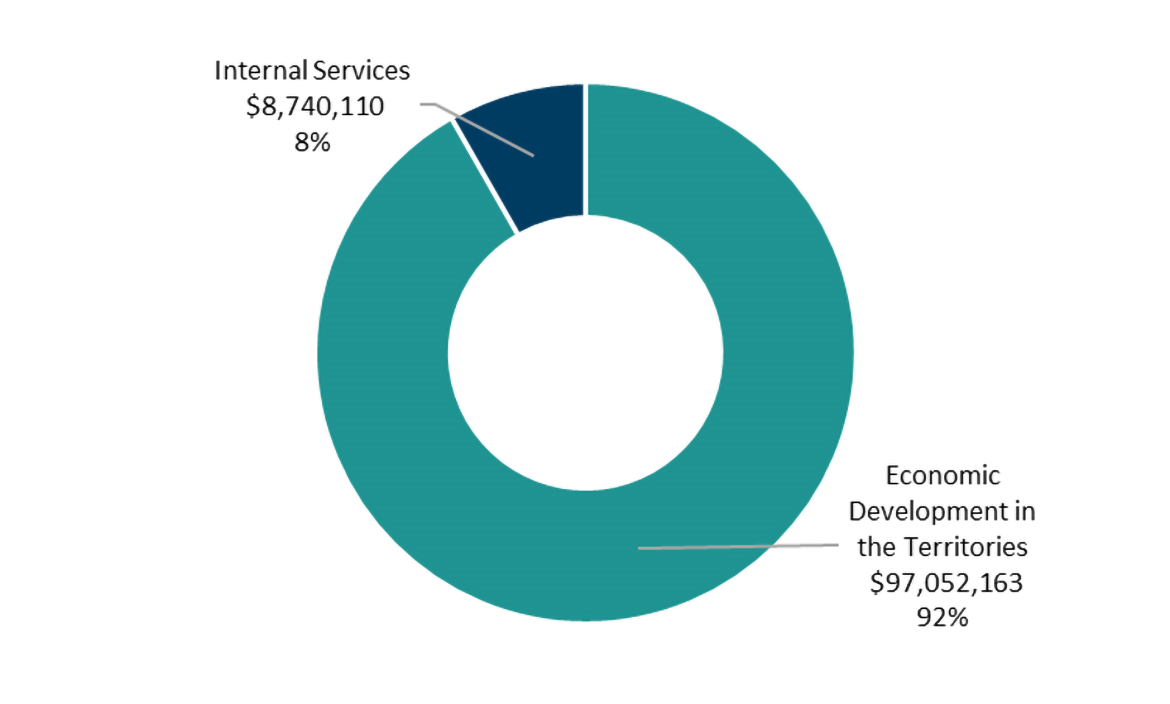
Text alternative for Figure 1: Actual spending by core responsibility in 2025–26
| Core responsibilities and internal services | 2025–26 actual spending |
|---|---|
| Economic Development in the Territories | $97,052,163 |
| Internal services | $8,740,110 |
Analysis of actual spending by core responsibility
Internal services spending is reflective of CanNor's status as a small agency and the costs associated with working and being headquartered in the North (e.g., northern isolated post allowances for employees). In 2025–26, internal services represented 8% of total spending. While these expenditures remained relatively stable, they did not increase at the same pace as program spending under core responsibilities. As a result, the proportion of internal services decreased in 2025–26, reflecting higher overall spending on grants and contributions. CanNor will continue supporting Northerners as they seize economic opportunities, promote economic innovation and diversification, build capacity and develop skilled workforces, and encourage job growth by making strategic investments.
Budgetary performance summary
Table 7 shows the money that CanNor spent in each of the past three years on its core responsibilities and on internal services.
| Core responsibilities and internal services | 2025–26 Main Estimates | 2025–26 total authorities available for use | Actual spending over three years (authorities used) |
|---|---|---|---|
| Economic Development in the Territories | $74,726,504 | $109,090,314 |
|
| Subtotal | $74,726,504 | $109,090,314 |
|
| Internal services | $3,108,536 | $3,455,616 |
|
| Total | 77,835,040 | 112,545,930 |
|
Analysis of the past three years of spending
Actual expenditures for fiscal years 2023–2024 to 2025–2026 reflect all parliamentary appropriations, including the Main Estimates, Supplementary Estimates, and funding from the various Treasury Board votes.
The decrease in spending between fiscal years 2023–2024 and 2024–2025 is primarily attributable to the sunsetting of temporary funding measures announced in Budget 2021, including the Jobs and Growth Fund and the Canada Community Revitalization Fund.
The increase in 2025–26 is driven by time-limited investments in new initiatives such as the Yukon Gathering Place, RDII, RTRI and the Trade Infrastructure Strategy. These investments support strengthened northern participation in defence-related supply chains, improved economic resilience in the face of global trade disruptions, and regionally responsive infrastructure and community development priorities. This increase also reflects newly approved funding for Pilimmaksaivik.
The Finances section of the Infographic for CanNor on GC Infobase provides more financial information from previous years.
Planned spending for next three years
Table 8 shows CanNor's planned spending for each of the next three years on its core responsibilities and on internal services.
| Core responsibilities and internal services | 2026–27 planned spending | 2027–28 planned spending | 2028–29 planned spending |
|---|---|---|---|
| Economic Development in the Territories | $123,615,717 | $95,649,993 | $59,141,380 |
| Subtotal | $123,615,717 | $95,649,993 | $59,141,380 |
| Internal services | $10,647,359 | $8,006,361 | $7,450,699 |
| Total | $134,263,076 | $103,656,354 | $66,592,079 |
Analysis of the next three years of planned spending
Approved planned spending over the next three fiscal years reflects a year-over-year decrease due to the scheduled sunsetting of several time-limited initiatives after 2026–27, including the IDEANorth renewal, the Renewed Food Policy for Canada, and temporary enhancements to NIEOP.
The decrease also reflects measures implemented through the Comprehensive Expenditure Review, which was undertaken to reduce government spending. For CanNor, these measures include the scheduled sunsetting of the Tourism Growth Program in 2026, representing $890K, with tourism-related activities continuing to be eligible for support through IDEANorth. They also include reductions related to REGI Core and RHII Housing, representing $5.45M, where lower demand and overlap with IDEANorth activities related to housing and innovation were identified. In addition, the NICI program, representing $2.94M, is scheduled to end in 2027, while food security priorities across the territories will continue to be supported through IDEANorth.
These reductions reflect the conclusion of targeted, time-bound funding measures and comprehensive expenditure review decisions rather than a change to CanNor's core mandate. The Agency will also manage a $2.02M core reduction through a combination of attrition, streamlined project intake, and overall operating efficiencies. Within this evolving fiscal context, the Agency will prioritize disciplined allocation of remaining resources toward high-impact investments that strengthen project readiness, Indigenous economic participation, regulatory coordination, and northern supply chain resilience.
The year-over-year decrease also reflects the scheduled sunsetting of the initiatives that drove the 2025–26 increase, as most were approved as time-limited, three-year funding. These include the Yukon Gathering Place, RDII, RTRI, and the Trade Infrastructure Strategy.
The Finances section of the Infographic for CanNor on GC Infobase provides more detailed financial information related to future years.
Funding
This section provides an overview of the department's voted and statutory funding for its core responsibilities and for internal services.
Graph 1 summarizes the department's approved voted and statutory funding from 2023–24 to 2028–29.
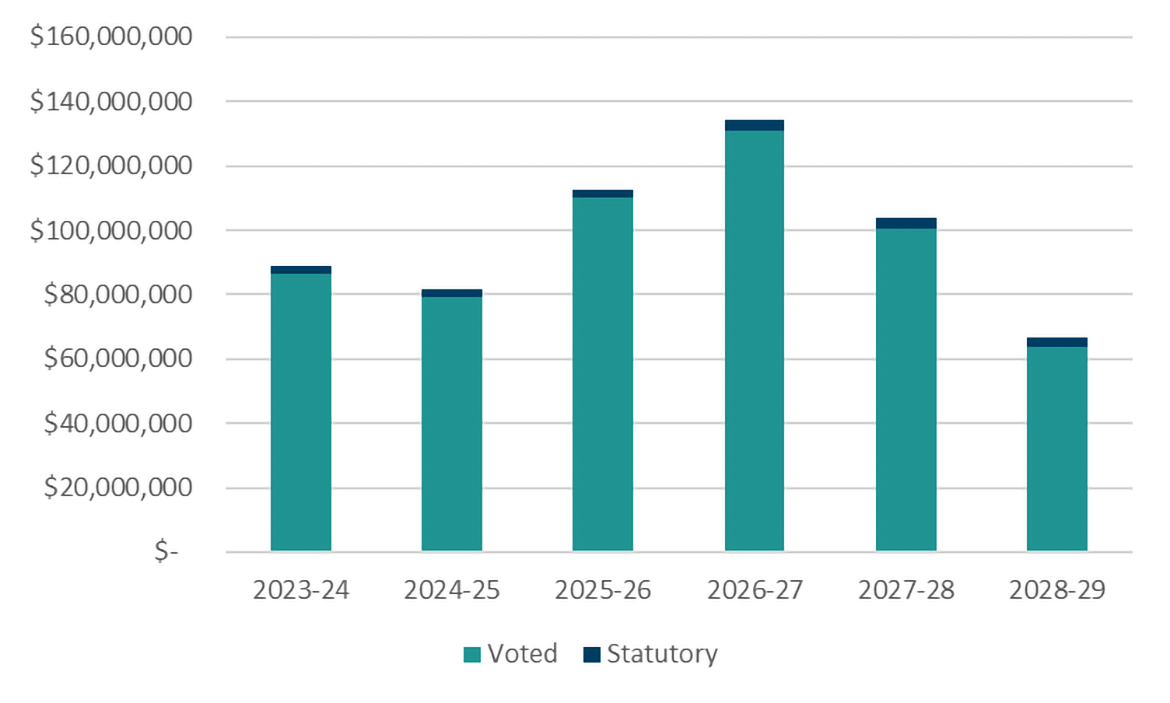
Text alternative for Graph 1: Approved funding (statutory and voted) over a six-year period
| Fiscal year | Statutory | Voted | Total |
|---|---|---|---|
| 2023–24 | $2,140,214 | $86,653,451 | $88,793,665 |
| 2024–25 | $2,223,485 | $79,155,065 | $81,378,550 |
| 2025–26 | $2,539,863 | $110,006,067 | $112,545,930 |
| 2026–27 | $3,408,462 | $130,854,614 | $134,263,076 |
| 2027–28 | $2,958,377 | $100,697,977 | $103,656,354 |
| 2028–29 | $2,728,356 | $63,863,723 | $66,592,079 |
Analysis of statutory and voted funding over a six-year period
The decrease in spending between fiscal years 2023–2024 and 2024–2025 is primarily attributable to the sunsetting of temporary funding measures announced in Budget 2021, including the Jobs and Growth Fund and the Canada Community Revitalization Fund.
Funding levels are expected to increase between 2024–25 and 2026–27, despite reductions resulting from the Comprehensive Expenditure Review. These reductions include decreases to base funding and the phasing out of several temporary programs, including REGI, NICI, and the TGP. However, the impact of these reductions is offset in the short term by new time-limited investments, including the Yukon Gathering Place, RDII, RTRI, SNID, and increased funding for Pilimmaksaivik, which is projected to nearly quadruple by 2028–29.
The decrease in 2027–28 and 2028–29 reflects the scheduled sunsetting of these time-limited initiatives, as well as the expiry of the time limited portion of funding for IDEANorth and NIEOP. As a result, overall funding levels decline in the later years of the planning period as temporary increases end and CER-related reductions continue to be reflected in the Agency's reference levels.
Consult the Public Accounts of Canada for further information on CanNor's departmental voted and statutory expenditures.
Financial statement highlights
This section presents CanNor's Financial statements (unaudited) for the year ended March 31, 2026.
Table 10 summarizes the expenses and revenues for 2025–26, which net to the cost of operations before government funding and transfers.
| Financial information | 2025–26 actual results | 2025–26 planned results | Difference (actual results minus planned) |
|---|---|---|---|
| Total expenses | $93,332,210 | $66,321,102 | $27,011,108 |
| Total revenues | $33,627 | $0 | $33,627 |
| Net cost of operations before government funding and transfers | $93,298,583 | $66,321,102 | $26,977,481 |
Analysis of expenses and revenues for 2025–26
There is a difference in actual results compared to planned results for total expenses because the 2025–26 planned results were based on Main Estimates. Subsequently, CanNor received additional spending authorities via Supplementary Estimates (B) and Supplementary Estimates (C). For total revenues, the planned results were based on historical trends. In 2025–26, additional revenue from an unanticipated insurance payout related to crown assets was added.
The 2025–26 planned results information is provided in CanNor's Future-Oriented Statement of Operations and Notes 2025–26.
Table 11 summarizes actual expenses and revenues and shows the net cost of operations before government funding and transfers.
| Financial information | 2025–26 actual results | 2024–25 actual results | Difference (2025–26 minus 2024–25) |
|---|---|---|---|
| Total expenses | $93,332,210 | $74,067,405 | $19,264,805 |
| Total revenues | $33,627 | $64 | $33,563 |
| Net cost of operations before government funding and transfers | $93,298,583 | $74,067,341 | $19,231,242 |
Analysis of differences in expenses and revenues between 2024–25 and 2025–26
There is a difference between 2025–26 actual results and 2024–25 actual results largely because CanNor received new additional authorities via Supplementary Estimates (B) and Supplementary Estimates (C) in fiscal year 2025–26. Most of those additional authorities were in transfer payments that directly increased expenses.
Table 12 provides a brief snapshot of the amounts the department owes or must spend (liabilities) and its available resources (assets), which helps to indicate its ability to carry out programs and services.
| Financial information | Actual fiscal year (2025–26) | Previous fiscal year (2024–25) | Difference (2025–26 minus 2024–25) |
|---|---|---|---|
| Total net liabilities | $50,683,762 | $42,767,935 | $7,915,826 |
| Total net financial assets | $49,291,144 | $41,450,070 | $7,841,074 |
| Departmental net debt | $1,392,617 | $1,317,865 | $74,752 |
| Total non-financial assets | $534,705 | $536,093 | $-1,388 |
| Departmental net financial position | $-857,912 | $-781,772 | $-76,140 |
Analysis of department's liabilities and assets since last fiscal year
There has been no meaningful change to the departmental net financial position from 2024–25 to 2025–26. Total net liabilities did increase significantly because of a rise in accounts payable and accrued liabilities related to additional payables at year-end in transfer payments. Total net financial assets also increased significantly because of a decrease in accounts receivable resulting in an increase in the amount due from the Consolidated Revenue Fund. Additionally, loans receivable increased substantially in fiscal year 2025–26.
Human resources
This section presents an overview of the department's actual and planned human resources from 2023–24 to 2028–29.
Table 13 shows a summary in full-time equivalents of human resources for CanNor's core responsibilities and for its internal services for the previous three fiscal years.
| Core responsibilities and internal services | 2023–24 actual full-time equivalents | 2024–25 actual full-time equivalents | 2025–26 actual full-time equivalents |
|---|---|---|---|
| Economic Development in the Territories | 83 | 86 | 91 |
| Subtotal | 83 | 86 | 91 |
| Internal services | 33 | 30 | 33 |
| Total | 116 | 116 | 124 |
Analysis of human resources for the last three years
The increase in full-time equivalents (FTEs) for 2025–26 compared to 2024–25 reflects both the filling of previously vacant positions (7% vacancy rate in 2024–25) and the staffing of positions approved for Pilimmaksaivik.
The increase in staffing levels reflects efforts to stabilize workforce capacity and align internal resources with evolving northern priorities.
Table 14 shows the planned full-time equivalents for each of CanNor's core responsibilities and for its internal services for the next three years. Human resources for the current fiscal year are forecast based on year to date.
| Core responsibilities and internal services | 2026–27 planned full-time equivalents | 2027–28 planned full-time equivalents | 2028–29 planned full-time equivalents |
|---|---|---|---|
| Economic Development in the Territories | 114 | 99 | 82 |
| Subtotal | 114 | 99 | 82 |
| Internal services | 38 | 33 | 27 |
| Total | 152 | 132 | 109 |
Analysis of human resources for the next three years
Planned FTE levels increase in 2026–27 to 152 to support previously approved priority initiatives, including the RDII, SNID, Pilimmaksaivik and strengthened regulatory coordination and project readiness functions. Together, these factors align staffing capacity with heightened demand related to infrastructure sequencing, defence-related economic participation, and economic resilience measures.
FTE levels decline beginning in 2027–28, reflecting the scheduled sunsetting of several time-limited initiatives, including the Tourism Growth Program, RDII, the Trade Infrastructure Strategy as well as the expiry of time-limited portions of IDEANorth and NIEOP. The decrease also reflects CER-related reductions and adjustments to base funding.
The planned reduction to 109 FTEs by 2028–29 reflects a managed transition to a streamlined operating structure focused on core mandate delivery, disciplined resource allocation, and high-impact economic development priorities.
Supplementary information tables
The following supplementary information tables are available on CanNor's website:
Federal tax expenditures
The tax system can be used to achieve public policy objectives through the application of special measures such as low tax rates, exemptions, deductions, deferrals and credits. The Department of Finance Canada publishes cost estimates and projections for these measures each year in the Report on Federal Tax Expenditures. This report also provides detailed background information on tax expenditures, including descriptions, objectives, historical information and references to related federal spending programs as well as evaluations and GBA Plus of tax expenditures.
Corporate information
Departmental profile
Appropriate minister(s): The Honourable Rebecca Chartrand, Minister of Northern and Arctic Affairs and Minister responsible for the Canadian Northern Economic Development Agency
Institutional head: Jimi Onalik
Ministerial portfolio: Canadian Northern Economic Development Agency
Enabling instrument(s): Public Service Rearrangement and Transfer of Duties Act, R.S.C. 1985, c. P-34
Year of incorporation or commencement: 2009
Departmental contact information
Mailing address: 200 – 1106 Iqaluktuutiak Drive Iqaluit, Nunavut X0A 3H0 Canada
Telephone: 1-855-897-2667
Email: infonorth-infonord@cannor.gc.ca
Website(s): Canadian Northern Economic Development Agency
Definitions
- appropriation (crédit)
- Any authority of Parliament to pay money out of the Consolidated Revenue Fund.
- budgetary expenditures (dépenses budgétaires)
- Operating and capital expenditures; transfer payments to other levels of government, departments or individuals; and payments to Crown corporations.
- core responsibility (responsabilité essentielle)
- An enduring function or role of a department. The departmental results listed for a core responsibility reflect the outcomes that the department seeks to influence or achieve.
- Departmental Plan (plan ministériel)
- A report that outlines the anticipated activities and expected performance of an appropriated department over a three-year period. Departmental Plans are usually tabled in Parliament in spring.
- departmental priority (priorité)
- A plan, project or activity that a department focuses and reports on during a specific planning period. Priorities represent the most important things to be done or those to be addressed first to help achieve the desired departmental results.
- departmental result (résultat ministériel)
- A high-level outcome related to the core responsibilities of a department.
- departmental result indicator (indicateur de résultat ministériel)
- A quantitative or qualitative measure that assesses progress toward a departmental result.
- departmental results framework (cadre ministériel des résultats)
- A framework that connects the department's core responsibilities to its departmental results and departmental result indicators.
- Departmental Results Report (rapport sur les résultats ministériels)
- A report outlining a department's accomplishments against the plans, priorities and expected results set out in the corresponding Departmental Plan.
- Full-time equivalent (équivalent temps plein)
- Measures the person years in a departmental budget. An employee's scheduled hours per week divided by the employer's hours for a full-time workweek calculates a full-time equivalent. For example, an employee who works 20 hours in a 40-hour standard workweek represents a 0.5 full-time equivalent.
- Gender-based Analysis Plus (GBA Plus) (analyse comparative entre les sexes plus [ACS Plus])
- An analytical tool that helps to understand the ways diverse individuals experience policies, programs and other initiatives. Applying GBA Plus to policies, programs and other initiatives helps to identify the different needs of the people affected, the ways to be more responsive and inclusive, and the methods to anticipate and mitigate potential barriers to accessing or benefitting from the initiative. GBA Plus goes beyond biological (sex) and socio-cultural (gender) differences to consider other factors, such as age, disability, education, ethnicity, economic status, geography (including rurality), language, race, religion, and sexual orientation.
- government priorities (priorités pangouvernementales)
- For the purpose of the 2025–26 Departmental Results Report, government priorities are the high-level themes outlining the government's agenda as announced in the 2025 Speech from the Throne.
- horizontal initiative (initiative horizontale)
- A program, project or other initiative where two or more federal departments receive funding to work collaboratively on a shared outcome usually linked to a government priority, and where the ministers involved agree to designate it as horizontal. Specific reporting requirements apply, including that the lead department must report on combined expenditures and results.
- Indigenous business (entreprise autochtones)
- Requirements for verifying Indigenous businesses for the purposes of the departmental result report are available through the Indigenous Services Canada Mandatory minimum 5% Indigenous procurement target website.
- non budgetary expenditures (dépenses non budgétaires)
- Net outlays and receipts related to loans, investments and advances, which change the composition of the financial assets of the Government of Canada.
- performance (rendement)
- What a department did with its resources to achieve its results, how well those results compare to what the department intended to achieve, and how well lessons learned have been identified.
- performance indicator (indicateur de rendement)
- A qualitative or quantitative measure that assesses progress toward a departmental-level or program-level result, or the expected outputs or outcomes of a program, policy or initiative.
- plan (plan)
- The articulation of strategic choices, which provides information on how a department intends to achieve its priorities and associated results. Generally, a plan will explain the logic behind the strategies chosen and tend to focus on actions that lead to the expected result.
- planned spending (dépenses prévues)
- For Departmental Plans and Departmental Results Reports, planned spending refers to the amounts presented in Main Estimates. Departments must determine their planned spending and be able to defend the financial numbers presented in their Departmental Plans and Departmental Results Reports.
- program (programme)
- An Individual, group, or combination of services and activities managed together within a department and focused on a specific set of outputs, outcomes or service levels.
- program inventory (répertoire des programmes)
- A listing that identifies all the department's programs and the resources that contribute to delivering on the department's core responsibilities and achieving its results.
- result (résultat)
- An outcome or output related to the activities of a department, policy, program or initiative.
- statutory expenditures (dépenses législatives)
- Spending approved through legislation passed in Parliament, other than appropriation acts. The legislation sets out the purpose and the terms and conditions of the expenditures.
- target (cible)
- A quantitative or qualitative, measurable goal that a department, program or initiative plans to achieve within a specified time period.
- voted expenditures (dépenses votées)
- Spending approved annually through an appropriation act passed in Parliament. The vote also outlines the conditions that govern the spending.